
- The way you give to charity could save you thousands in retirement taxes. A Qualified Charitable Distribution (QCD) allows eligible retirees age 70½ and older to donate directly from an IRA without counting the donation as taxable income. In our example, this simple change saved a couple $2,024 in federal taxes on the same $10,000 gift.
- A QCD can reduce more than just your income tax bill, but the details matter. Lowering your adjusted gross income could help reduce taxes on Social Security, preserve valuable deductions, and potentially avoid higher Medicare premiums. However, the money must go directly from your IRA to an eligible charity to qualify.
How to Save Thousands in Retirement Taxes With a Qualified Charitable Distribution (QCD)
What if you could give the exact same amount to charity and save thousands in taxes, just by changing how you give?
For retirees who regularly support charities, churches, or other nonprofits, one overlooked IRA strategy could make a surprising difference in their tax bill.
It's called a Qualified Charitable Distribution (QCD), and while the name sounds complicated, the concept is remarkably simple.
Instead of withdrawing money from your IRA and then writing a check to charity, you send the money directly from your IRA to the charitable organization. That one change can lower your taxable income without reducing the amount your favorite cause receives.
But there's a catch. Get the process wrong, and you could lose the tax benefit entirely.
Let's break down how QCDs work, how much they could save you, and when they actually make sense.
What Is a Qualified Charitable Distribution (QCD)?
A Qualified Charitable Distribution allows anyone age 70½ or older to transfer money directly from an eligible IRA to a qualified charity without including that distribution in taxable income.
In 2026, eligible individuals can give up to $111,000 through QCDs. Married couples with separate IRAs can each use their own limit.
This becomes especially valuable once Required Minimum Distributions (RMDs) enter the picture.
RMDs force retirees to withdraw a portion of their traditional retirement accounts each year, whether they need the money or not. Those withdrawals generally count as taxable income, potentially pushing retirees into higher tax brackets.
A QCD offers another option.
If you already plan to give to charity, you can direct some or all of your RMD to an eligible organization instead. The distribution still counts toward your annual RMD requirement, but the qualifying amount stays out of your taxable income.
The charity receives the same donation. You potentially pay less in taxes.
Why a QCD Can Beat a Traditional Charitable Donation
Most people assume charitable tax savings come from itemizing deductions. However, many retirees take the standard deduction because it provides a larger tax benefit.
For 2026, a married couple filing jointly, with both spouses over age 65, qualifies for a $35,500 standard deduction.
Under the new rules taking effect in 2026, married couples who don't itemize can also deduct up to $2,000 in qualifying cash donations.
That helps, but a QCD works differently.
Rather than giving you a deduction after the income reaches your tax return, a QCD keeps the qualifying distribution out of your adjusted gross income (AGI) altogether.
Why does that matter?
Your AGI influences more than your federal income tax bracket. It can also affect:
- Social Security taxation: Higher income can increase how much of your Social Security benefits become taxable.
- Medicare premiums: Income above certain thresholds can trigger higher Medicare Part B and Part D premiums through IRMAA.
- The enhanced senior deduction: Eligible taxpayers age 65 and older can claim an additional $6,000 deduction per person, but income limits can reduce that benefit.
- Overall tax planning: Lower income can create opportunities elsewhere in your retirement strategy.
A QCD won't improve every one of these factors for every retiree. Still, reducing AGI can sometimes produce benefits that go well beyond the donation itself.
How One Couple Could Save $2,024 on the Same $10,000 Donation
Let's look at a hypothetical example using 2026 federal tax rules.
Meet a married couple, both age 75, with the following retirement income:
- $50,000 in annual Social Security benefits
- $120,000 in required minimum distributions
- $10,000 in interest and dividends
- $10,000 in annual charitable donations
They give $10,000 to their church every year and take the standard deduction.
Now, let's compare two ways they could make that exact same donation.
Scenario 1: They Write a Check
First, the couple withdraws their full $120,000 RMD and deposits the money into their bank account.
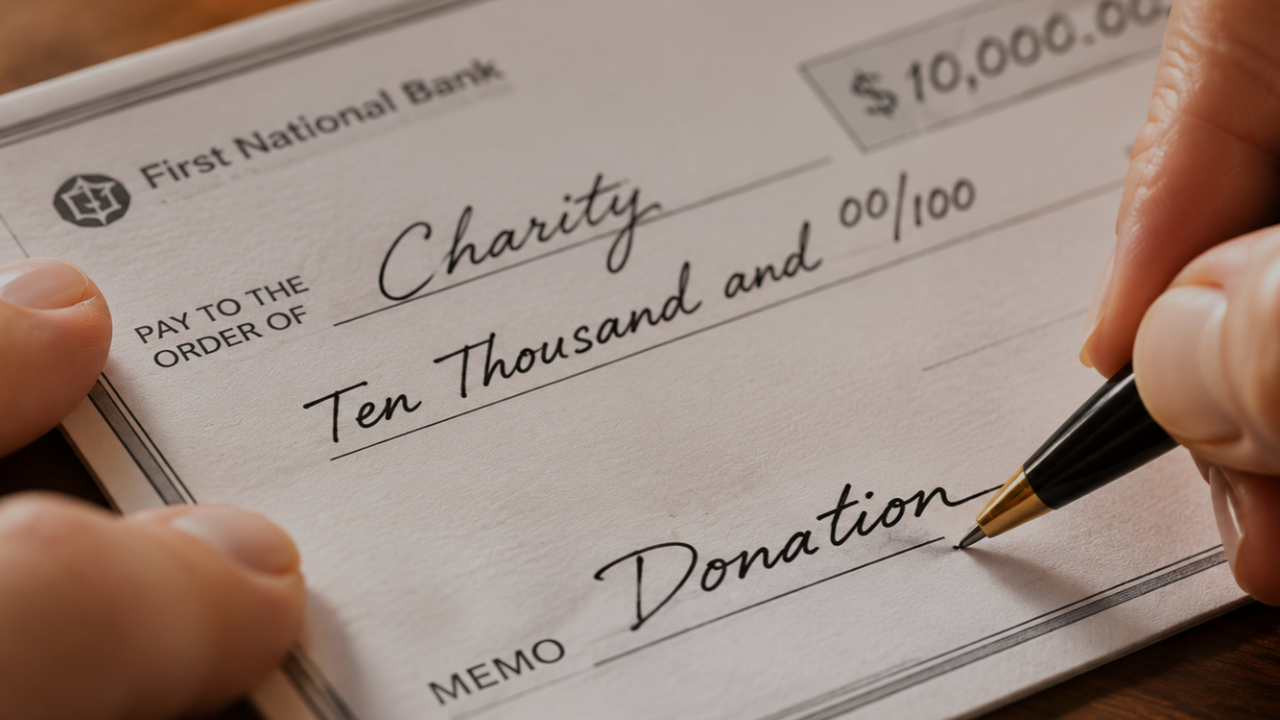
They then write a $10,000 check to their church.
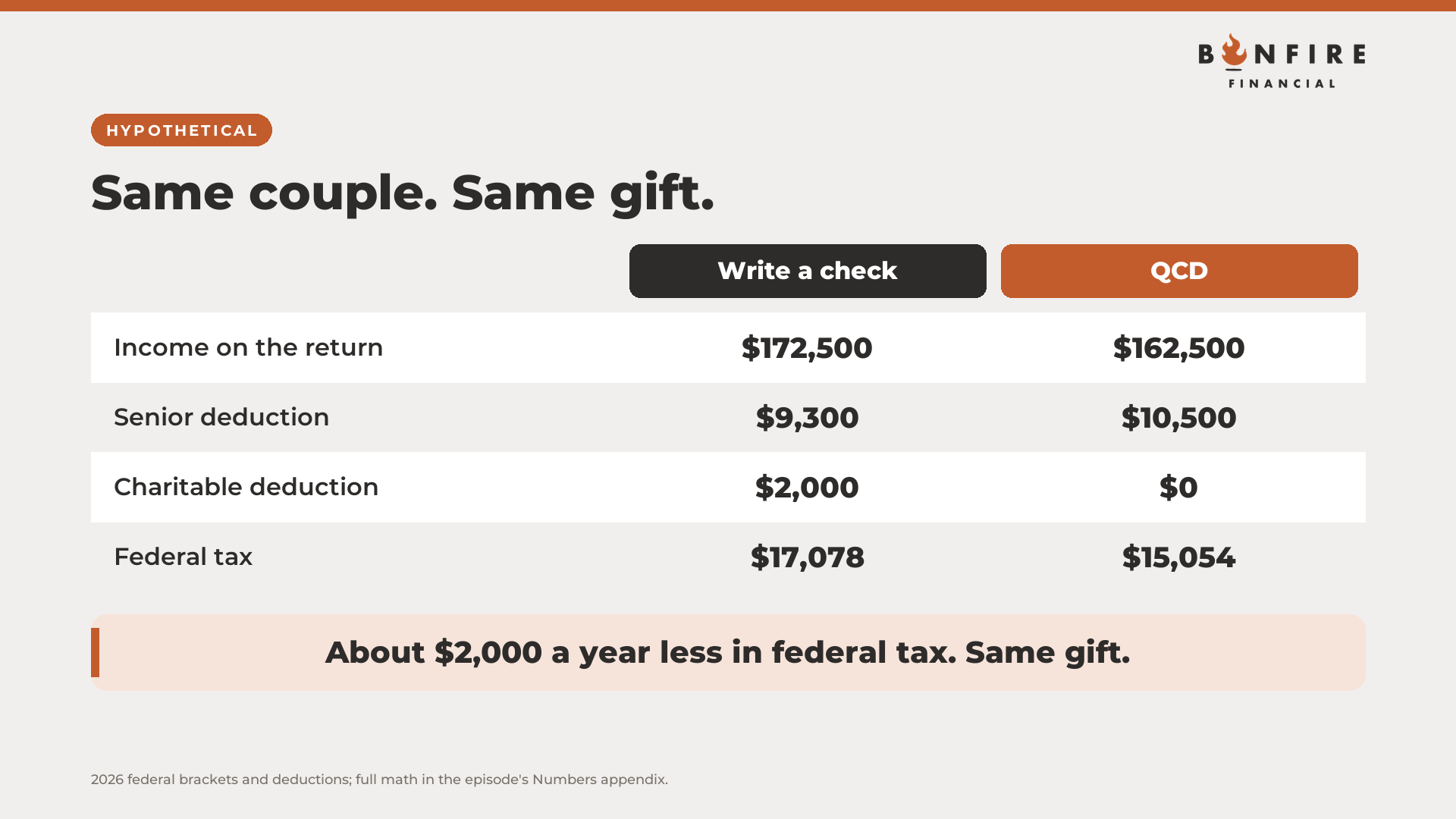
This approach brings their adjusted gross income to approximately $172,500. Because their income exceeds the threshold for the enhanced senior deduction, they lose part of that additional tax benefit.
Even after accounting for their standard deduction, senior deduction, and the $2,000 charitable deduction for non-itemizers, their estimated federal income tax comes to $17,078.
Scenario 2: They Make a QCD
Now, imagine the couple takes a different approach.
Rather than withdrawing the full RMD themselves, they direct their IRA custodian to send $10,000 straight to the church. They withdraw the remaining $110,000 to satisfy their RMD.
Their adjusted gross income drops to approximately $162,500.
That lower income allows them to retain more of their enhanced senior deduction. Although they no longer receive the separate $2,000 charitable deduction on that gift, the overall tax savings more than make up for it.
Their estimated federal income tax falls to $15,054.
The Difference?
Same couple. Same church. Same $10,000 donation.
More than $2,000 in annual federal tax savings, simply by changing how they give.
For someone who makes charitable donations year after year, that difference can add up.
Of course, your actual savings will depend on your income, tax bracket, deductions, and overall financial situation.
In this particular example, the QCD doesn't lower the couple's Medicare premiums because their income already falls below the applicable IRMAA threshold. Another couple closer to that threshold could see an additional benefit.
The QCD Rules You Can't Afford to Get Wrong
While QCDs offer attractive tax advantages, several rules can trip up even experienced retirees.
1. The Money Must Go Directly to Charity
This is the most important requirement.
Your IRA custodian must send the donation directly to the charitable organization. If you withdraw the money into your personal bank account first, you lose the QCD treatment.
Even if you immediately donate every dollar, the IRS generally treats that withdrawal as taxable income.
2. Not Every Charity Qualifies
Most traditional public charities qualify, including churches, universities, and food banks.
However, donor-advised funds, supporting organizations, and most private foundations don't qualify for QCD treatment.
Verify the organization's eligibility before initiating the transfer.
3. Timing Matters
You must complete your QCD within the applicable tax year, typically by December 31.
Waiting until the final days of December can create unnecessary complications, especially when your custodian processes checks or other distributions.
There's another important timing consideration: If you've already satisfied your entire RMD for the year, you can't retroactively convert that withdrawal into a QCD.
Planning your charitable gifts before taking your RMD can help you avoid this problem.
4. You Can't Receive Something in Return
A QCD must represent a qualifying charitable gift. You generally can't use one to purchase gala tickets, pay for a charitable dinner, or receive other benefits in exchange.
Keep documentation from the charity acknowledging your contribution.
5. Your Tax Return Must Reflect the QCD
Even when you follow every distribution rule correctly, mistakes can happen during tax preparation.
Your IRA custodian reports distributions on Form 1099-R, and you need to ensure your tax preparer correctly identifies the qualifying charitable distribution.
Otherwise, you could accidentally pay taxes on money that should have remained outside your taxable income.
Is a QCD Worth It?
For retirees who already donate to charity, a QCD can offer one of the more straightforward ways to reduce taxes.
You don't need to purchase a financial product, make an additional investment, or increase your charitable giving.
In most cases, the strategy involves little or no additional cost beyond any fees your IRA custodian may charge.
However, QCDs aren't for everyone.
If you don't already give to charity, donating $10,000 just to save $2,000 in taxes doesn't improve your financial position. You still part with $10,000.
Similarly, retirees in lower tax brackets may see relatively modest savings. Those who rely on donor-advised funds for charitable giving will need to consider other options.
And once your donation reaches the charity, you can't undo it.
The key question isn't whether QCDs offer a tax benefit. It's whether that benefit fits your existing charitable goals and retirement plan.
Can You Make a QCD Before RMDs Begin?
Yes, and this is a detail many retirees overlook.
You become eligible to make QCDs at age 70½, even if you haven't reached the age when required minimum distributions begin.
While these early QCDs won't satisfy a future RMD, they can reduce your IRA balance and potentially lower required distributions in later years.
For retirees with substantial traditional IRA balances, that creates another opportunity to coordinate charitable giving with long-term tax planning.
The Bottom Line: It's Not How Much You Give, but How You Give
Retirement tax planning doesn't always require complicated strategies or dramatic changes.
Sometimes, the biggest opportunity comes from doing something you already planned to do, just a little differently.
A Qualified Charitable Distribution can help eligible retirees support the causes they care about while potentially reducing taxable income, preserving valuable deductions, and managing future tax exposure.
But the details matter.
Before making a QCD, consider your RMD obligations, charitable giving goals, income, and other retirement tax strategies.
At Bonfire Financial, we believe the best financial decisions come from understanding how every piece of your retirement plan works together.
Through the Bonfire Method, we help you connect your taxes, retirement income, investments, insurance, and estate planning into one coordinated strategy.
Because the goal isn't just to save money on taxes. It's to make more of your money work toward the retirement you actually want.
Questions people ask
What is a Qualified Charitable Distribution (QCD), and how does it reduce my taxes?
A Qualified Charitable Distribution (QCD) allows individuals age 70½ or older to donate directly from an eligible IRA to a qualified charity without counting the donation as taxable income. Instead of claiming a charitable deduction, you keep that money out of your adjusted gross income. This can lower your federal tax bill and potentially help reduce taxes on Social Security benefits or avoid higher Medicare premiums.
Can I use a QCD to satisfy my Required Minimum Distribution (RMD)?
Yes. A QCD can count toward your annual Required Minimum Distribution (RMD), allowing you to meet your withdrawal requirement without paying income taxes on the qualifying charitable portion. However, timing matters. You must complete the QCD before satisfying your full RMD for the year. Once you've withdrawn the money personally, you can't retroactively convert it into a QCD.
Is it better to donate directly from my IRA or write a check to charity?
If you're at least 70½ and already give to charity, donating directly from your IRA may offer greater tax benefits than writing a personal check. A QCD keeps the qualifying donation out of your taxable income, while a traditional charitable donation may provide only a limited deduction. In our hypothetical example, a retired couple saved $2,024 in federal taxes on the same $10,000 donation simply by using a QCD. Your actual savings depend on your income, deductions, and tax situation.