

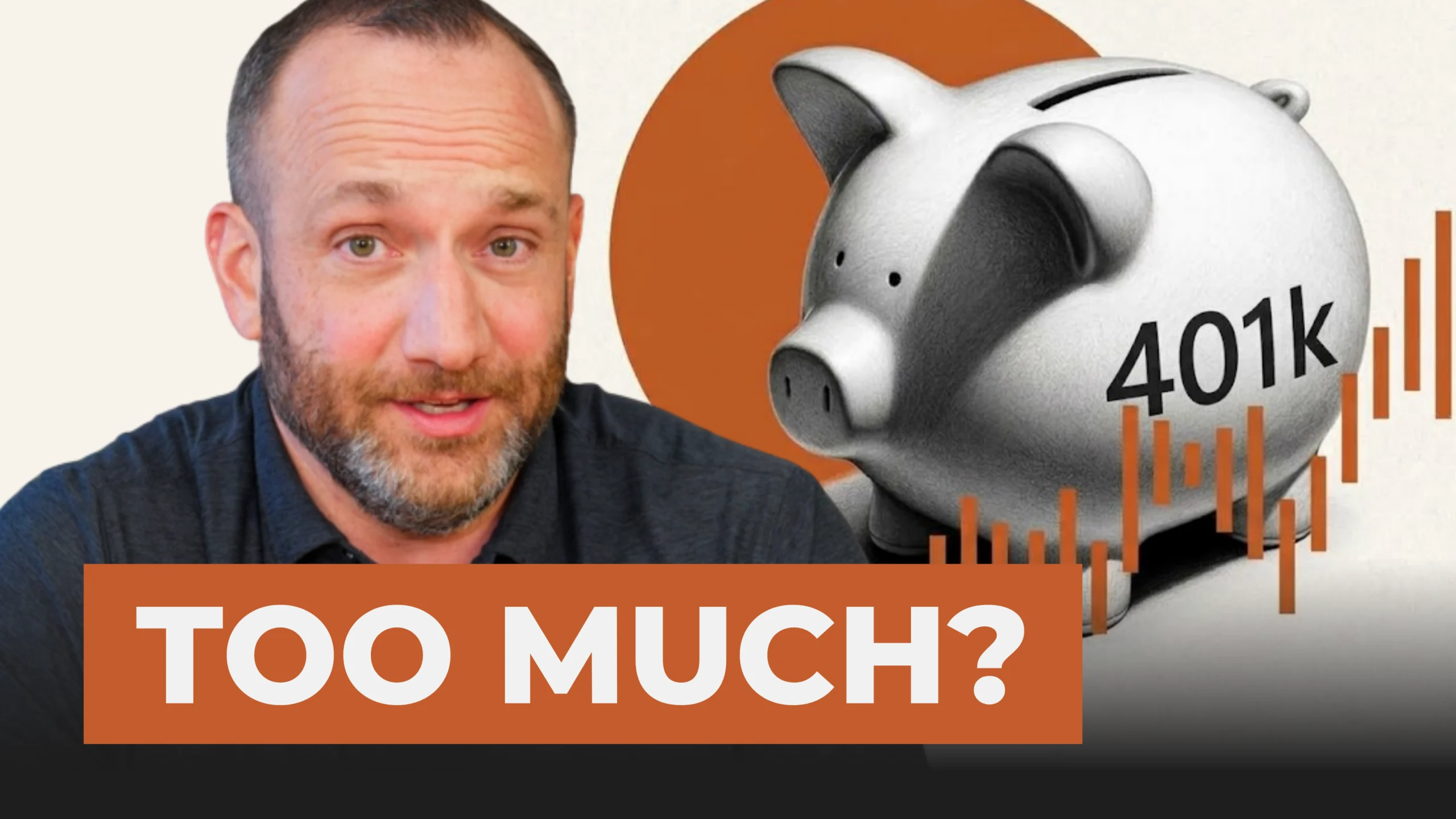
Did I Make A Mistake Putting All My Money in a Traditional 401(k)?

401(k) Mistakes That Could Cost You More in Retirement

For years, I did exactly what many Americans do with their retirement savings. I put money into a Traditional 401(k), took the tax deduction, and assumed I would pay a lower tax rate once I retired.

The strategy sounded smart. In fact, it represented standard retirement advice for decades.

Then I started looking at the entire picture.

Instead of focusing only on the tax deduction today, I ran the numbers from the beginning of a career through retirement withdrawals and required minimum distributions. That exercise changed how I think about one of the most common 401(k) decisions.

The potential mistake isn’t saving in a 401(k). Saving consistently can create substantial wealth over time.

The question is when you want to pay the tax.

Traditional 401(k) vs. Roth 401(k): What’s the Difference?

A Traditional 401(k) gives you a tax benefit today.

You contribute money before federal income tax, which can reduce your taxable income for the year. The money then grows tax-deferred until you withdraw it in retirement.

At that point, the IRS taxes your withdrawals as ordinary income.

A Roth 401(k) flips that arrangement.

You pay taxes on your income before contributing to the account. Once the money enters the Roth 401(k), qualified withdrawals can come out tax-free later.

Both accounts can hold the same investments. Both can experience the same investment growth. The major difference comes down to when you pay the tax.

That distinction may look small when you’re filling out a benefits enrollment form. Over several decades, it can become much more significant.

The 401(k) Tax Break Feels Pretty Good Today

Consider someone earning $200,000 a year and contributing $24,500 annually to a 401(k).

Using the assumptions from our example, choosing the Traditional 401(k) instead of the Roth reduces the person’s federal tax bill by about $5,880 for the year.

That’s roughly $490 every month.

Most people can find plenty of ways to use an extra $490.

Mortgage payments, vacations, groceries, braces, cars, kids, and everyday life can absorb that money quickly. Over a 35-year career, those annual tax savings total about $205,800 in additional take-home pay in our hypothetical example.

That benefit matters,  but it represents only one side of the equation.

The Bigger Question Comes When You Start Taking 401(k) Withdrawals

Here’s where one of the most overlooked 401(k) mistakes can occur.

People often focus heavily on the tax deduction they receive while working without thinking as carefully about how taxes may affect their withdrawals later.

Imagine contributing $24,500 every year from age 30 through age 65 while earning an average hypothetical return of 7%. Under those assumptions, you contribute $857,500 and reach retirement with approximately $3.39 million.

The Traditional and Roth accounts can reach the exact same balance if you contribute the same amount and invest the money identically.

However, those account balances don’t necessarily represent the same amount of spendable money.

  • The Roth saver has already paid income taxes on the money contributed.
  • The Traditional 401(k) owner still owes taxes when the money comes out.

A $3 Million 401(k) Isn’t Necessarily $3 Million You Can Spend

Suppose you retire and want to withdraw $10,000 per month.

With qualified Roth withdrawals, you can generally take out $10,000 and have $10,000 available to spend.

A Traditional 401(k) works differently.

Every taxable withdrawal adds to your ordinary income. In the hypothetical example from our analysis, withdrawing $120,000 per year produced roughly $16,400 in federal income taxes under the assumptions used.

That leaves approximately $8,600 per month after federal taxes.

Want the same $10,000 of monthly spending power as the Roth retiree?

You would need to withdraw closer to $11,800 per month in the example.

As a result, you may need to pull more money from the account to support the same lifestyle.

But Aren’t You Supposed to Be in a Lower Tax Bracket in Retirement?

Maybe. In fact, our hypothetical example assumes exactly that.

The person receives a deduction at a 24% marginal federal tax rate while working, then experiences an effective federal tax rate of roughly 14% on the modeled retirement withdrawal.

So the old advice wasn’t necessarily wrong.

It simply didn’t tell the entire story.

You receive the original tax deduction on the money you contribute.

Later, you pay taxes on the contributions plus decades of investment growth when you withdraw the money.

Think of it this way.

You avoided paying tax on the seed. Eventually, the IRS can tax the harvest.

That difference becomes increasingly important as the account grows.

Required Minimum Distributions Can Change the Equation Again

Traditional retirement accounts come with another consideration: required minimum distributions, commonly called RMDs.

Under current rules reflected in our example, someone born in 1960 or later generally starts RMDs at age 75. Those born from 1951 through 1959 generally begin at 73.

At that point, you don’t get to decide whether you want to withdraw money from the Traditional account.

The IRS requires a minimum amount each year.

Imagine someone reaching age 75 with an untouched Traditional 401(k) worth approximately $6.66 million.

In our hypothetical scenario, the first required distribution comes to roughly $270,800.

That creates approximately $57,300 in federal income tax under the assumptions we modeled.

A Roth 401(k), by contrast, does not require lifetime RMDs for the original owner under current rules.

That difference can create considerably more flexibility when you’re managing taxable income in retirement.

What If You’re Already in Your 50s?

This conversation becomes especially relevant for people who already have significant retirement savings.

You can’t go back and change how you contributed twenty years ago.

You can decide what you do with your next contribution.

Our second example looked at someone who reaches age 55 earning $200,000 with $1 million already accumulated inside a Traditional 401(k).

Instead of continuing to make Traditional contributions, that person directs the next ten years of contributions into the Roth side of the plan.

The additional taxes total about $58,800 over those ten working years in the example.

By age 65, the Roth portion grows to roughly $338,500.

At age 75, it reaches approximately $666,000.

Because less money remains subject to required distributions, the person’s first modeled RMD drops from roughly $184,000 to $157,000.

The first-year tax difference equals about $6,750 under the model. Over time, the gap continues to grow.

The bigger benefit may come from flexibility.

That retiree now controls a pool of Roth money that can potentially fund large expenses without increasing taxable income.

  • Maybe you want to buy a car.
  • Perhaps you’re helping a child purchase a home.
  • You could need money for travel, healthcare, home renovations, or another major expense.

Having both taxable and tax-free retirement accounts can give you more choices when deciding where that money comes from.

Why Do So Many People Ignore the Roth 401(k)?

Inertia plays a big role.

Vanguard’s How America Saves 2026 report found that 98% of the plans in its dataset offered a Roth feature at the end of 2025.

Only 18% of participants who had access to Roth directed any contributions toward it.

Other research cited in our analysis found a similar pattern.

Many employees simply continue using whatever retirement election they made when they first enrolled.

People change jobs, raise families, buy homes, and manage careers. Most don’t spend their free time rereading their employee benefits paperwork.

Unfortunately, a decision someone makes in their 20s or 30s can quietly continue for decades.

Is a Traditional 401(k) a Mistake?

Not necessarily.

A Traditional 401(k) can make sense in certain situations, particularly when someone’s current tax rate substantially exceeds the rate they expect to pay later.

Employer matching also matters.

If your employer offers a 401(k) match, taking advantage of that benefit often deserves priority regardless of whether the employer contribution lands in a Traditional or Roth account.

Your income, current tax bracket, future income needs, retirement date, Social Security strategy, investment assets, estate plan, and state taxes can all influence the decision.

That’s why framing this as simply “Roth good, Traditional bad” misses the point.

The bigger 401(k) mistake may come from making the choice once and never looking at it again.

One Question to Ask Before Your Next 401(k) Contribution

Instead of asking only:

How much can I save on taxes this year?

Consider another question:

How much control do I want over my taxes in retirement?

Retirement planning doesn’t stop with accumulating the biggest account balance possible. You also need to think about how you’ll eventually turn that balance into spendable income.

For years, I looked at my Traditional 401(k) and saw retirement savings. Now I see something slightly different.

Part of that balance belongs to me. Another portion represents a future tax obligation whose exact size I don’t yet know.

That’s why I approach my own contributions differently today.

The goal isn’t simply to build the biggest number on a statement. It’s to understand how much of that number you’ll actually get to use.

Your 401(k) Is Only One Piece of the Retirement Puzzle

Choosing between a Traditional and Roth 401(k) matters, but that decision shouldn’t happen in isolation.

Your retirement income, taxes, investments, Social Security, insurance, and estate plan all affect one another. A strategy that looks smart in one area can create unintended consequences somewhere else.

That’s why the goal isn’t simply to accumulate more money. It’s to build a retirement strategy that helps you understand what you have, what you’ll need, and how each piece works together.

The Bonfire Method brings those pieces into one coordinated plan. Over four meetings and 30 days, we look at your investments, taxes, retirement income, insurance, and estate planning to help you see the full picture before making major retirement decisions.

If you’re approaching retirement and wondering whether your current strategy is really working together, learn more about the Bonfire Method and see what your retirement plan may be missing.


Roth Conversion Strategies: Build Wealth for Your Family, Not the IRS

When it comes to building wealth and leaving a financial legacy, most people focus on how much they can accumulate. But what many overlook is how much of that money will actually reach their family, and how much could end up going to the IRS instead.

One of the most powerful yet underutilized strategies in estate and tax planning is Roth conversion strategies. While often discussed in the context of retirement planning, Roth conversions can play a key role in reducing the future tax burden on your heirs and maximizing the impact of the wealth you leave behind.

Today we’ll break down exactly how Roth conversions work, why they’re valuable for estate planning, and how to decide whether this strategy is right for you.

Listen Now:  iTunes |  Spotify | iHeartRadio | Amazon Music

What Is a Roth Conversion?

A Roth conversion is the process of transferring money from a traditional retirement account (like a traditional IRA or 401k) into a Roth IRA. When you make the conversion, you pay ordinary income tax on the amount you transfer, but after that, the funds grow tax-free, and withdrawals are also tax-free, assuming the account has been open for at least five years and you’re over age 59½.

People often use Roth conversions when they expect to be in a higher tax bracket later or want to maximize tax-free income in retirement. But there’s another layer to this strategy: reducing the tax burden on your heirs.

Why Roth Conversions Matter for Estate Planning

Thanks to recent tax law changes under the SECURE Act and SECURE 2.0, inherited IRAs now come with a strict timeline. If a non-spouse (such as a child) inherits your IRA, they must withdraw all the funds within 10 years, and those withdrawals are taxed as ordinary income.

This is a big shift from the previous “stretch IRA” rule that allowed beneficiaries to spread withdrawals over their lifetime. The new 10-year rule compresses the tax liability into a much shorter period, often hitting heirs during their peak earning years.

For example, let’s say your child earns $120,000 annually and inherits a $500,000 IRA. Instead of spreading withdrawals out over decades, they have to withdraw all the funds within 10 years. That could push their income over $170,000 in a given year, bumping them into a much higher tax bracket and significantly reducing what they ultimately get to keep.

By converting portions of your IRA to a Roth IRA during your lifetime, you pay the taxes now, and your heirs inherit an account that grows tax-free and can be withdrawn tax-free. Even though they still have to empty the account within 10 years, the absence of taxes makes it far more beneficial.

Real-World Example: A Client’s Legacy in Action

We recently worked with a client who brought her adult son to a financial planning meeting. She was a single woman in her 70s, financially secure, and had no need to rely on her IRA for living expenses. Her son, a successful professional, was in a significantly higher tax bracket than she was.

If she left her IRA untouched and passed away, her son would inherit a sizable sum and an equally sizable tax bill. Not only would he need to withdraw hundreds of thousands of dollars within a decade, but each withdrawal would be taxed at his current income rate.

By contrast, if she slowly converted the IRA into a Roth over a period of several years, carefully keeping each conversion within her lower tax bracket, she could shoulder the tax bill at her lower rate, allowing her son to inherit a Roth IRA instead. He would still need to withdraw the funds within 10 years, but he wouldn’t owe a dime in taxes.

The approach of evaluating Roth conversion strategies not only preserved more of the money for her family, but it gave them more flexibility and peace of mind during an emotionally difficult time.

Understanding the Tax Bracket “Fill” Strategy

One of the most practical ways to approach Roth conversions is through “tax bracket filling.” The idea is to make use of your current marginal tax bracket without tipping into the next one.

Here’s how it works:

Let’s say you’re a single filer with $60,000 in taxable income. The 22% federal income tax bracket in 2025 goes up to about $95,375. That means you could convert up to $35,375 of IRA money and still stay within the 22% bracket.

By “filling the bracket” with Roth conversions, you can transfer funds without triggering a jump into a higher tax tier. This is especially effective if you’re in a low-tax phase of life, such as early retirement, before taking Social Security or required minimum distributions (RMDs).

This strategy is repeatable year after year and can gradually shift large portions of your traditional IRA into a Roth IRA while minimizing your total lifetime tax liability.

Why Timing Matters for Roth Conversions

The effectiveness of a Roth conversion strategy often comes down to timing. The most advantageous window tends to be:

  • After retirement but before you begin collecting Social Security

  • Before you are required to take RMDs at age 73 (or 75, depending on your birth year)

  • During years when your income is temporarily lower (job transition, business loss, early retirement, etc.)

In these windows, your marginal tax rate may be much lower than what it will be in future years, or what your heirs will face.

It’s also important to think about where tax policy is heading when considering Roth conversion strategies. Many financial professionals believe federal income taxes are likely to increase in the coming decades due to growing national debt and budget deficits. Paying taxes today, when rates are relatively low, could be a smart long-term decision.

A Closer Look at the 10-Year Inheritance Rule

The SECURE Act’s 10-year rule means that non-spouse beneficiaries must completely drain an inherited IRA within a decade. While there’s no rule that says the withdrawals must be taken evenly each year, they must be completed by the end of year 10.

The downside? If the heir waits too long and takes a large lump sum at the end of the 10 years, it could cause an enormous tax spike.

This rule does not apply to Roth IRAs in the same way. Beneficiaries still have to follow the 10-year withdrawal rule, but distributions are tax-free, as long as the Roth account has been open for at least 5 years.

That means your heirs can:

  • Let the money grow tax-free for up to a decade

  • Withdraw it at a time that suits their financial situation

  • Avoid adding taxable income during their highest-earning years

Who Should Consider Roth Conversions for Estate Planning?

Roth conversion strategies are especially effective for individuals who meet the following criteria:

1. Retired and in a lower tax bracket than their children
If your income has decreased but your children are in their peak earning years, it makes sense for you to pay the taxes now so they don’t get hit with a much larger tax bill later.

2. Financially secure and not dependent on IRA withdrawals
If you don’t need your traditional IRA for day-to-day expenses, you can afford to strategically convert and handle the tax costs over time.

3. Planning to leave a large IRA to heirs
The larger the IRA, the greater the potential tax burden on your beneficiaries. Roth conversions reduce this future liability.

4. Wanting to reduce estate size for tax purposes
While estate tax only affects a small percentage of families, converting to a Roth can reduce your estate’s taxable size while still preserving value for your heirs.

5. Believing tax rates will go up in the future
If you suspect federal income tax rates will increase over the next 10–20 years, locking in today’s lower rates could be a wise move.

When Roth Conversions Might Not Make Sense

Like all financial planning tools, Roth conversions aren’t right for everyone. Situations where it might not be ideal include:

You need the money now
If you rely on your IRA for income, the added tax burden of a conversion might not be worth it.

You’re currently in a high tax bracket
If your current tax rate is higher than what your heirs will face, paying the taxes now may not make sense.

You plan to donate the IRA to charity
Qualified charities don’t pay taxes on IRA distributions. Leaving your IRA to a nonprofit could be more efficient than converting it to a Roth.

You can’t afford the taxes from the conversion
Ideally, taxes on a conversion should be paid from cash savings, not from the IRA itself. If you have to dip into the converted funds to cover the tax bill, the strategy loses a lot of its effectiveness.

Debunking Common Roth Conversion Myths

Let’s address a few common misunderstandings:

Roth conversions are only for young investors
Reality: Roth conversions can be especially effective for retirees and those doing estate planning, especially if their tax bracket is lower than their heirs’.

You’ll lose money by paying taxes now
Reality: Paying taxes now at a lower rate can save money in the long run, especially if future tax rates are higher.

Roth IRAs don’t help with inheritance planning
Reality: Roth IRAs can be a powerful inheritance tool, especially under the 10-year rule — no required taxes means more flexibility and value for your heirs.

How to Execute a Roth Conversion Estate Strategy

If you’re considering this strategy, here are a few key steps to follow:

Step 1: Run Projections
Work with a CFP® or tax professional to analyze your current and future tax brackets, your heirs’ tax situations, and your long-term retirement needs.

Step 2: Start Small and Be Strategic
Don’t convert your entire IRA in one year. Spread conversions over several years to manage your tax bracket and avoid triggering unintended Medicare or Social Security impacts.

Step 3: Use Non-IRA Funds to Pay the Taxes
To get the full value of the conversion, pay the taxes using cash from savings. That keeps the entire converted amount growing tax-free.

Step 4: Communicate Your Plan  
Make sure your heirs understand what you’ve done and why. Update your beneficiaries and document your estate plan accordingly.

Final Thoughts: Taxes Are Inevitable, But Smart Planning Isn’t

At the end of the day, the choice often comes down to this: Would you rather your money go to your family, or to the IRS?

Roth conversion strategies allow you to take control of that decision. When used strategically, they can reduce the long-term tax burden, offer more flexibility to your heirs, and help ensure that the wealth you worked so hard to build actually benefits the people you care about most.

It’s not a one-size-fits-all solution, but it’s one of the most powerful planning tools available if used at the right time, in the right way.

Need personalized Roth conversion strategies?

At Bonfire Financial, we help clients turn complex tax rules into smart, actionable strategies. We welcome you to schedule a call to see how Roth conversions could fit into your estate plan.

Thank You For Your Subscription

You’re in! Thanks for subscribing to our monthly newsletter. We will be sending you market updates, financial insights and inspiring travel ideas soon but in the meantime check out our blog, join us on Instagram or pop over to Pinterest.

Your Appointment Request has been Received

Thank you for reaching out! We are excited to learn more about you. Someone from our team will be in touch shortly.

Sign up now

Join us around the fire for monthly market updates, financial insights and inspiring travel ideas.

.

Sign up now

Receive tips

Give us a call

(719) 394.3900
(844) 295.0069