What to do with an Inherited IRA (And the Mistakes to Avoid)

What to do with an Inherited IRA

Inheriting an IRA is very common financial event that families face, yet it is also one of the most misunderstood.

Almost everyone will deal with an inherited IRA at some point, whether from a spouse, parent, or other loved one. IRAs, 401ks, and Roth accounts are some of the most widely held assets today. And since none of us get out of here alive, these accounts almost always pass to someone else.

Yet despite how common inherited IRAs are, they remain one of the top topics we discuss with clients on a daily basis. The rules have changed. The tax implications can be significant. And the decisions you make, or fail to make, can quietly cost you hundreds of thousands of dollars over time.

The good news is this: Inheriting an IRA is a good problem to have. It means someone cared enough to leave you something meaningful. But like many good problems, it still needs to be solved thoughtfully.

Today will walk through how inherited IRAs work, the differences between Roth and traditional inherited IRAs, the 10-year rule, common mistakes to avoid, and why planning matters more than ever.

Listen Now: iTunes | Spotify | iHeartRadio | Amazon Music

Why Inherited IRAs Deserve Special Attention

For many families, an inherited IRA is not a small account. It can easily be several hundred thousand dollars or more. In some cases, it is the largest asset someone inherits. What makes inherited IRAs tricky is that the rules are very different depending on who you are, what type of account you inherited, and when the original owner passed away.

If you treat an inherited IRA like a regular investment account, you can end up with unexpected tax bills, forced distributions at the worst possible time, or missed planning opportunities.

This is why inherited IRAs are not something you want to handle on autopilot.

The Two Types of Inherited IRAs

At a high level, there are two types of inherited IRAs you can receive:

  1. An inherited Roth IRA

  2. An inherited traditional IRA or inherited 401(k)

While they share a name, they behave very differently. Understanding which one you inherited is the first and most important step.

Inherited Roth IRAs: The Simpler Side

Let’s start with inherited Roth IRAs because they are far easier to understand and manage.

How Roth IRAs Work

A Roth IRA is funded with after-tax dollars. The original account owner already paid taxes on the money that went in. As a result, the money grows tax free.

Roth IRAs are not subject to required minimum distributions during the original owner’s lifetime. That alone makes them one of the most powerful long-term planning tools available.

If You Inherit a Roth IRA as a Spouse

If you inherit a Roth IRA from your spouse, the process is simple. The account rolls into your own Roth IRA.

There are no required minimum distributions. There is no complicated rule set to follow. It becomes your account, and you can continue to let it grow tax free.

This is one of the cleanest transitions in financial planning.

If You Inherit a Roth IRA as a Non-Spouse

If you are not the spouse, which includes children, grandchildren, siblings, or anyone else, you fall under what is known as the 10-year rule. This rule requires that the inherited Roth IRA be fully depleted within 10 years of the original owner’s death.

Here is the key point. There is no required annual distribution. You can take out as much or as little as you want in any given year, as long as the account is fully emptied by the end of year 10.

A Common and Often Optimal Strategy

For most people who do not need the money immediately, the simplest strategy is to let the inherited Roth IRA grow untouched for the full 10 years.

Since the money continues to grow tax free, allowing it to compound for as long as possible often makes sense. At the end of year 10, you withdraw the entire balance and move it into an individual or joint investment account.

There is no tax bill when you do this. That is the beauty of a Roth.

If you need the money earlier, you can access it at any time without penalty or taxes. There are no restrictions forcing you to wait. This flexibility is why Roth IRAs are such a powerful asset to inherit and why we encourage people to fund Roth accounts whenever possible.

Inherited Traditional IRAs: More Moving Parts

Now let’s move to the inherited traditional IRA or inherited 401(k). This is where planning becomes critical.

How Traditional IRAs Work

Traditional IRAs and 401(k)s are funded with pre-tax dollars. The original account owner received a tax deduction when the money went in. The account then grew tax deferred.

Taxes are owed when the money comes out.

When you inherit one of these accounts, the tax bill does not disappear. It simply transfers to you.

If You Inherit a Traditional IRA as a Spouse

Just like with a Roth, if you inherit a traditional IRA from your spouse, the process is relatively simple.

The account rolls into your own IRA. From there, it follows the normal required minimum distribution rules based on your age.

This is usually straightforward and does not require special strategies beyond normal retirement planning.

If You Inherit a Traditional IRA as a Non-Spouse

This is where most mistakes happen.

As a non-spouse beneficiary, you are subject to the 10-year rule. The account must be fully depleted within 10 years.

Unlike an inherited Roth IRA, every dollar you withdraw from a traditional inherited IRA is taxed as ordinary income at your current tax rate.

This is where the real planning challenge begins.

Understanding the Tax Impact

Let’s look at a simple example.

Assume you earn $150,000 per year. You inherit a traditional IRA and decide to take out $50,000 this year.

Your taxable income is now $200,000.

That additional income could push you into a higher tax bracket, increase your state taxes, and potentially trigger other consequences like higher Medicare premiums later in life.

Now imagine inheriting a $1 million IRA.

If you wait too long and are forced to withdraw the entire balance in the final year, that million dollars is added on top of your regular income in a single year.

That is a tax bill almost no one enjoys paying.

The Mistake of Only Taking Required Minimum Distributions

If the original account owner was already subject to required minimum distributions, those RMDs continue in the inherited IRA.

Here is the issue. Taking only the RMDs does not satisfy the 10-year rule.

The math simply does not work.

You could take RMDs every year and still be left with a large balance at the end of year 10. At that point, you are forced to withdraw everything remaining, regardless of tax consequences.

This is one of the most common mistakes we see.

The “One-Tenth Per Year” Strategy and Its Limitations

Some people attempt a simple approach by withdrawing one-tenth of the account each year. While this feels logical, it has a hidden flaw.

The account is still invested. If the portfolio grows at a similar rate to your withdrawals, the balance may not meaningfully decline. You could reach year 10 and still be staring at a large taxable balance that must be distributed all at once.

This is why inherited IRAs require more than a simple formula.

Why Timing Matters More Than Amount

With inherited traditional IRAs, timing is often more important than how much you withdraw.

The goal is not just to empty the account. The goal is to do so in a way that minimizes taxes over the full 10-year period.

That may mean taking larger distributions in lower-income years. It may mean spreading withdrawals unevenly. It may mean coordinating withdrawals with retirement, a business sale, or other life events.

There is no one-size-fits-all solution.

Medicare Premiums and Other Hidden Consequences

For those approaching or already on Medicare, inherited IRA distributions can impact more than just income taxes. Higher income can increase Medicare Part B and Part D premiums through what is known as IRMAA surcharges.

These premium increases are often overlooked, but they can significantly raise healthcare costs for years. This is another reason careful planning matters.

Qualified Charitable Distributions as a Strategy

Inherited traditional IRAs still allow for qualified charitable distributions, or QCDs, once you reach age 70 and a half. A QCD allows you to donate directly from your IRA to a qualified charity. The amount donated is not included in your taxable income. This can be a powerful tool for those who are charitably inclined and in higher tax brackets.

However, eligibility depends entirely on your age when you inherit the IRA. If you inherit it earlier in life, this option may not be available. It is very much a matter of timing and circumstance.

Why You Should Not Wait Until Year 10

One of the biggest mistakes we see is inaction.

People inherit an IRA, feel overwhelmed, and decide to deal with it later. Before they know it, several years have passed. Waiting until the final year almost guarantees a painful tax outcome.

Planning early gives you flexibility. Waiting removes it.

Estate Planning and Beneficiary Designations Matter

Inherited IRAs are also a reminder of how critical beneficiary designations are. These accounts pass by beneficiary designation, not by your will.

If beneficiaries are outdated, incorrect, or incomplete, the money may not go where you intended. And once the original owner passes, there is usually nothing that can be done to change it.

We recommend reviewing beneficiaries at least annually or anytime a major life event occurs. Divorces, remarriages, births, deaths, and family changes all warrant a review. This small administrative step in your estate planning can prevent significant family conflict later.

Making a Difficult Situation Easier

Losing a loved one is already hard. Financial confusion should not add to the burden.

While inherited IRAs can feel complex, the goal of planning is simple. Make a difficult situation as easy and tax-efficient as possible.

With the right strategy, inherited IRAs can be managed thoughtfully and responsibly. Without one, they can quietly create unnecessary stress and taxes.

The Bottom Line

Inherited IRAs are common. Mishandling them is also common. Roth inherited IRAs are generally straightforward and flexible. Traditional inherited IRAs require careful, proactive planning. The 10-year rule changed the landscape, and the old strategies no longer work the way they used to. Doing nothing is rarely the right move.

If you have inherited an IRA, or expect to, this is an area where working with a financial advisor and a tax professional is not just helpful, it is essential.

If you want help evaluating your situation and building a plan that fits your life, your income, and your goals, we are always here to help. At Bonfire Financial, our goal is simple. Help you make smart decisions so you can retire the way you want, without paying more in taxes than necessary.

Give us a call today to get help with your inherited IRA.

The Power of Catch-Up Contributions

The benefit of aging: Catch-Up Contributions

In the most recent episode of The Field Guide Podcast, Brian Colvert, CFP®, takes a fresh look at aging – not as a decline, but as a time brimming with opportunities, especially when it comes to building a secure retirement. Brian dives into the often-underutilized benefits of increasing contributions to retirement accounts as you get older, demonstrating how these seemingly small tweaks can significantly impact your financial future.

Listen Now:

iTunes |  Spotify | iHeartRadio | Amazon Music | Castbox 

Leveraging Catch-Up Contributions: A Detailed Look:

One of the perks of aging is the ability to contribute more to retirement accounts like IRAs, 401(k)s, and HSAs. Let’s break down the specifics and explore why maximizing these contributions is crucial.

IRAs and Roth IRAs:  The standard contribution limit for both Traditional and Roth IRAs for 2024 sits at $7,000.  >> Click here to see this year’s limits << However, individuals aged 50 and above are eligible for Catch-up contributions, allowing them to add an extra $1,000, bringing their total contribution to a substantial $8,000. Don’t let high income discourage you; strategies like the Backdoor Roth conversion can help you take advantage of these benefits, even if your income exceeds the Roth IRA contribution limits. Here’s a deeper dive into the backdoor Roth conversion:

Backdoor Roth Conversion: A Backdoor Roth is a strategy that involves contributing to a traditional IRA and then converting those funds to a Roth IRA. There are tax implications associated with this conversion, but for those who wouldn’t qualify for a direct Roth IRA contribution due to income restrictions, it can be a valuable way to access the tax-free growth benefits of a Roth IRA in retirement.

Company Plans: Similar benefits exist for company-sponsored plans like SIMPLE IRAs and 401(k)s. Catch-up contributions are available for those over 50, allowing them to significantly increase their contributions and accelerate retirement savings. Let’s explore some additional considerations for company plans:

Employer Matching: Many employers offer matching contributions on employee contributions to retirement plans. This essentially translates to free money for your retirement. Be sure to contribute at least enough to capture your employer’s full match. It’s like leaving free money on the table if you don’t!

Investment Options: Company plans often offer a variety of investment options within the plan. Understanding your risk tolerance and investment time horizon is crucial when choosing how to allocate your contributions within the plan. We recommend seeking guidance from a CERTIFIED FINANCIAL PLANNER™ regarding your best investment options.

The Power of Compounding Interest with Your Catch-Up Contributions

Here’s where the magic truly happens: compounding interest. Even seemingly small additional contributions can snowball into a significant sum over time. Consider this: a $1,000 extra contribution to an IRA each year, consistently invested for 15 years with a moderate 6% rate of return, could grow into over $23,000. This is the magic of compounding interest working in your favor. Let’s delve a little deeper into the concept of compounding interest:

Exponential Growth: Compound interest allows your money to grow exponentially over time. Your earnings not only come from your initial contributions but also from the interest earned on those contributions. This creates a snowball effect, accelerating the growth of your retirement savings.

Time is Your Ally: The longer your money is invested, the greater the impact of compounding interest. Starting to contribute to retirement savings early and taking advantage of catch-up contributions later allows you to maximize the power of compounding interest.

HSA: A Tax-Advantaged Powerhouse – Unveiling the Benefits

The benefits extend beyond traditional retirement accounts. HSAs (Health Savings Accounts), often overlooked in retirement planning, offer additional avenues for saving.  Individuals aged 55 and above can contribute an extra $1,000 on top of the standard limits as of 2024.

>> Click here to see this year’s limits <<

Let’s explore the unique advantages of HSAs:

  • Triple Tax Advantage: HSAs boast a unique “triple tax advantage.” Contributions are tax-deductible, investment earnings grow tax-free, and qualified medical withdrawals are tax-free. This makes HSAs a powerful tool for saving for future medical expenses while minimizing your tax burden.
  • Portability: HSAs are portable, meaning the funds belong to you, not your employer. You can retain your HSA even if you change jobs, providing long-term financial security for healthcare costs.

Embrace the Silver Lining:

Growing older comes with its challenges, but it also unlocks valuable opportunities to solidify your financial future. By maximizing catch-up contributions and strategically utilizing retirement accounts, you can pave the way for a secure and comfortable retirement. Remember, you’re not alone in this journey. If you have any questions or need guidance on your retirement planning path, don’t hesitate to reach out.

Taking Action:

Catch-Up Contributions are just the start.  Here are some actionable steps you can take today:

  • Schedule a consultation with a CERTIFIED FINANCIAL PLANNER™: Discuss your retirement goals and explore personalized strategies to maximize catch-up contributions and retirement savings.
  • Research retirement account options: Understand the contribution limits, tax implications, and investment options for IRAs, Roth IRAs, 401(k)s, and HSAs.
  • Review your current contributions: Analyze your current contributions to retirement accounts and consider increasing them to take advantage of catch-up provisions.
  • Automate your contributions: Setting up automatic contributions ensures you’re consistently saving towards your retirement goals.

By taking these steps and embracing the opportunities that come with age, you can transform your retirement from a distant dream into a fulfilling reality.

Differences Between an IRA and 401k

IRA vs 401k: What’s the Difference:

There are some common misconceptions about the difference between an IRA (Individual retirement account) and a 401k plan. While these two are very similar there are some distinct differences that make each unique.

Before we tackle the difference between an IRA and a 401k it’s important to note that these are not investments.  They are simply accounts.  Just because you have an account open does not mean you have an investment that will grow and help fund your retirement.  Much the same way that just because you own a refrigerator doesn’t mean you actually have any food in it. You have to add to it.

To continue with this analogy…  in your fridge, you can have a variety of different types of food (juice, pickles, eggs, beer, and anchovies- if you’re into that sort of a thing). In an IRA and 401k you can have different investments too.  Such as stocks, bonds, mutual funds, ETFs, commodities, real estate, and more. You can also change or “throw out” the investments in your IRA or 401k if you’ve left them in the back of the fridge for too long. You know like that 3lb. jar of mayo you bought for that party that one time.

Now that you are hungry, let’s get to the dive-in.

Overview of an IRA vs. 401K:

You probably know fundamentally that saving for retirement is one of the single best things you can do financially. You don’t want to rely on social security, you don’t want to run out of money, you don’t want to be a financial burden to your children, and you want to enjoy your golden years. All great reasons to have a retirement plan! So which retirement plan is best for you?

Both IRAs and 401Ks have tax benefits and are among the most common defined contribution plans. The good news is that you don’t have to choose one over the other. To maximize your retirement savings, you can and should, if possible, contribute to both an IRA and 401k.

The key to note is that a 401k, named for the section of the tax code that discusses it, is an employer-based plan and an IRA is an individual retirement plan. Got it?

First up let’s look at how a 401K and IRA are alike.

The Similarities:

  • Both allow you to put money in on a tax-deferred basis. Meaning that taxes are not due at the time when you add money. For example, if you make $50,000 and decide to invest $2,000 of it into your IRA or 401k, the $2,000 is not going to be part of your taxable income.
  • Your money within an IRA or 401k can be invested in a variety of ways.
  • The money that is invested is allowed to grow tax-deferred. You do not have to pay taxes on the gains from your investments until you take the money out.  If you make $1,000 off of your $2,000 investment, you now have $3,000 in your account and you will not have to pay taxes on that gain until you withdrawal the money.
  • When you do withdrawal the money for whatever amount it will be considered part of your taxable income. You will own taxes on the withdrawal amount. Let’s say you withdrawal the $2,000 and your current annual income is $50,000 after the withdrawal your taxable income will be $52,000.
  • Since an IRA and 401k are designed for retirement the money that you invest is not supposed to withdraw until after the age of 59 ½. You read that correctly -the government added in a half, well, because your inner 6-year-old knows it’s that important. If you withdraw the money prior to 59 ½ you will pay a 10% penalty on the money plus the amount withdrawn is now part of your taxable income.
  • Also, the government mandates that at age 73 you have to take out a Required Minimum Distribution (RMD).  Basically, they tell you the amount that you must pay taxes on.  Quick note, if you are still employed at age 73 and not the owner of the company you can delay your RMDs.

The Differences:

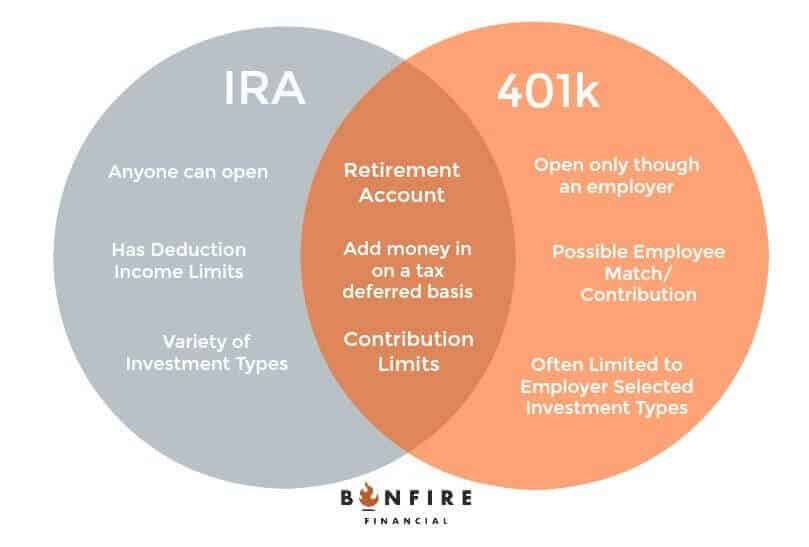
While an IRA and a 401k have many similarities, they do differ in a few very key areas.  The main one is that an IRA is an Individual Retirement Account, so it is yours and yours alone. Anyone can have one. A 401k is company-sponsored, so you can only participate in it if your employer offers one.  Some other key differences are:

  • Since a 401k is employer-sponsored, typically the employer will match a percentage of their employees’ contributions up to a certain limit or percentage. There is no option for this in an IRA.
  • Consequentially because a 401K is employer-sponsored your investment options are limited to what the employer offers. Whereas an IRA will allow you to have more variety in terms of stocks, bonds, real estate, etc.
  • Loan or hardship withdrawals are available for 401ks. However, IRAs generally do not permit loans or early withdrawals.
  • An IRA has certain income limits and a 401k does not.
  • Finally, the contribution limits are different and change from year to year. Feel free to give us a call to learn about the current years’ limits.


Difference Between an IRA and 401k- A Venn Diagram

Differences between an IRA and a 401k

Which is Right For You?

It depends, really. If you have the option of putting your money into an employer-sponsored 401k or an IRA you should do both. Max them out if possible. We recommend prioritizing the 401k first especially if your employer offers a match and then adding to an IRA if you are within the income limits.

This hopefully gives you a good overview of the differences between an IRA and a 401k. While there are many factors to consider, the most important thing to remember is that both are great tools to use to help achieve your retirement goals.

Are you interested in learning about a Roth?  We’ve got a great article here for you.

Have other questions? Please setup a call with us HERE!

Thank You For Your Subscription

You’re in! Thanks for subscribing to our monthly newsletter. We will be sending you market updates, financial insights and inspiring travel ideas soon but in the meantime check out our blog, join us on Instagram or pop over to Pinterest.

Your Appointment Request has been Received

Thank you for reaching out! We are excited to learn more about you. Someone from our team will be in touch shortly.

Sign up now

Join us around the fire for monthly market updates, financial insights and inspiring travel ideas.

.

Sign up now

Receive tips

Give us a call

(719) 394.3900
(844) 295.0069